
Things I want to do
Blender allows you to create two types of spheres: ICO spheres and UV spheres.
Here, we will compare two balls.
Environment
Blender:3.4.1.
Compare
overview
ICO Ball
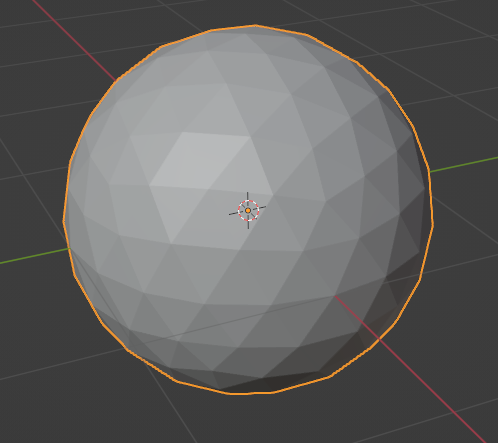
This is a sphere composed entirely of identical equilateral triangles.
It will become a regular N-hedron. (The default setting is a regular icosahedron.)
UV Balls
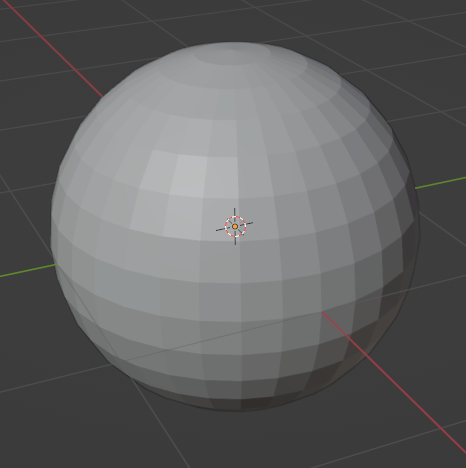
It is a sphere composed of square and triangular faces.
Only the plane connecting the top and bottom points is a triangle; the others are quadrilaterals. The quadrilaterals are not necessarily all the same shape.
Appearance
Creating an ICO sphere with subdivision ‘3’ results in the following:
Creating a UV sphere with segment ’32’ and ring ’16’ results in the following:
When people think of a 3D sphere, they probably imagine something like this.
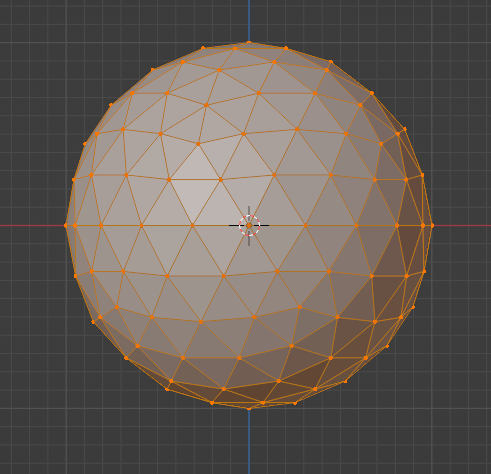
Next, let’s look at the ICO sphere from the side and from directly above. (Edges have been selected for clarity.)
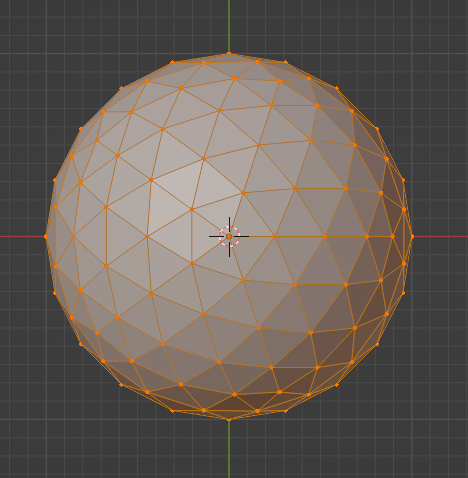
Next, let’s look at the UV sphere from the side and from directly above.
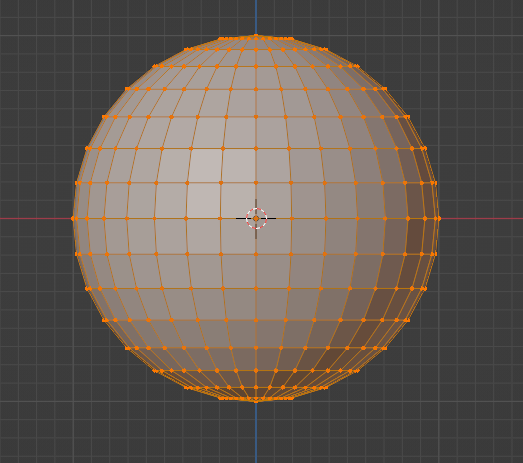
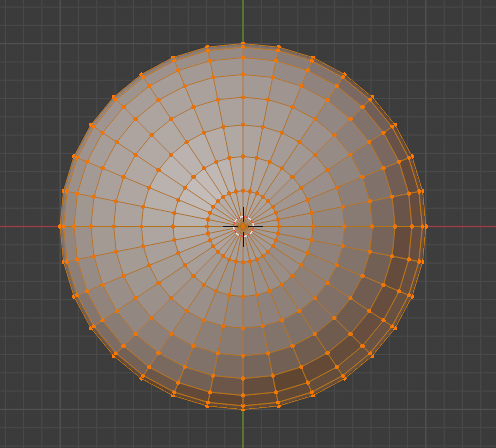
As you can see above, the ICO sphere produces a similar image from any angle. (However, you can also see that it’s not exactly the same.)
edit
Next, we will compare the edited versions.
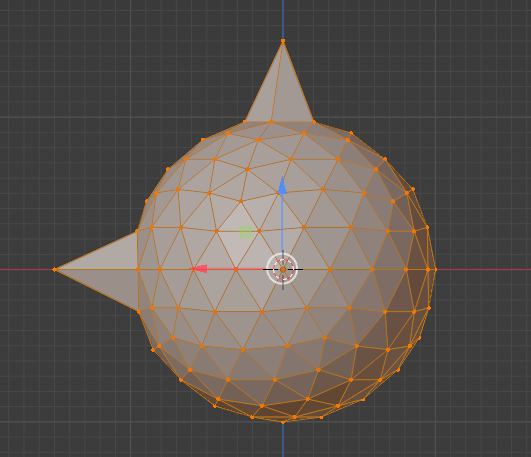
The image below shows the result of moving the top and leftmost points of the ICO sphere.
Although there is a difference in angle, you can see that the results are similar in the top and left images.
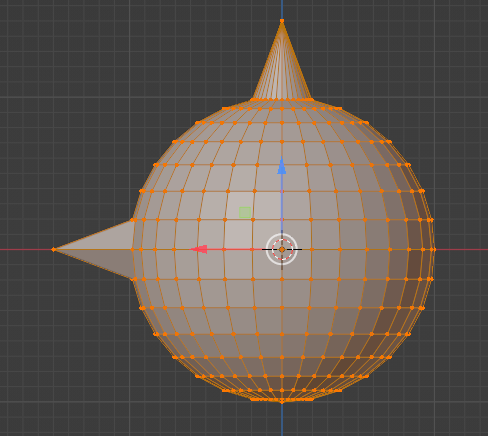
Next, perform the same operation with the UV bulb.
On the left, the shape is deformed into a square pyramidal form, but above, it is deformed into a cone-like shape, showing that the editing results are significantly different between the left and the top.
texture
Although there are no comparison images, I have seen descriptions suggesting that UV spheres are better when applying textures to spheres.
However, it can also be done with ICO spheres, so there doesn’t seem to be much difference.
Meshes that can be created
When creating an ICO sphere, you can set the subdivision value.
If the subdivision value is ‘2’, a regular icosahedron will be created.

When the subdivision value increases by 1, the number of faces created increases fourfold.
In other words, subdivision ‘3’ results in a regular octadecahedron, and subdivision ‘3’ results in a regular 320-sided polyhedron, so the setting is quite well described.
In UV spheres, you can set the number of segments (the number of divisions between upper and lower vertices) and the number of rings (the number of divisions around the entire circumference).
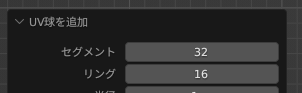
UV spheres allow for more detailed control over the mesh they create.
summary
| ICO Ball | UV Balls | |
| Appearance | The viewing direction (angle) has little effect. | The viewing direction (angle) has a significant impact. |
| edit | The difference in results depending on where you edit is small. | There is a significant difference in the results depending on where you edit. |
| texture | weak point? | good at? |
| create | Cannot set detailed settings | Detailed settings are available. |
Websites I used as references


コメント